FSSAI Plans New Warning Labels: Red Alert on Food Packs For Easy Identification of Sugary and Fatty Foods
FSSAI Proposes Red Hexagon Warning Label to help consumers identify packaged foods high in sugar, fat and salt quickly and easily.

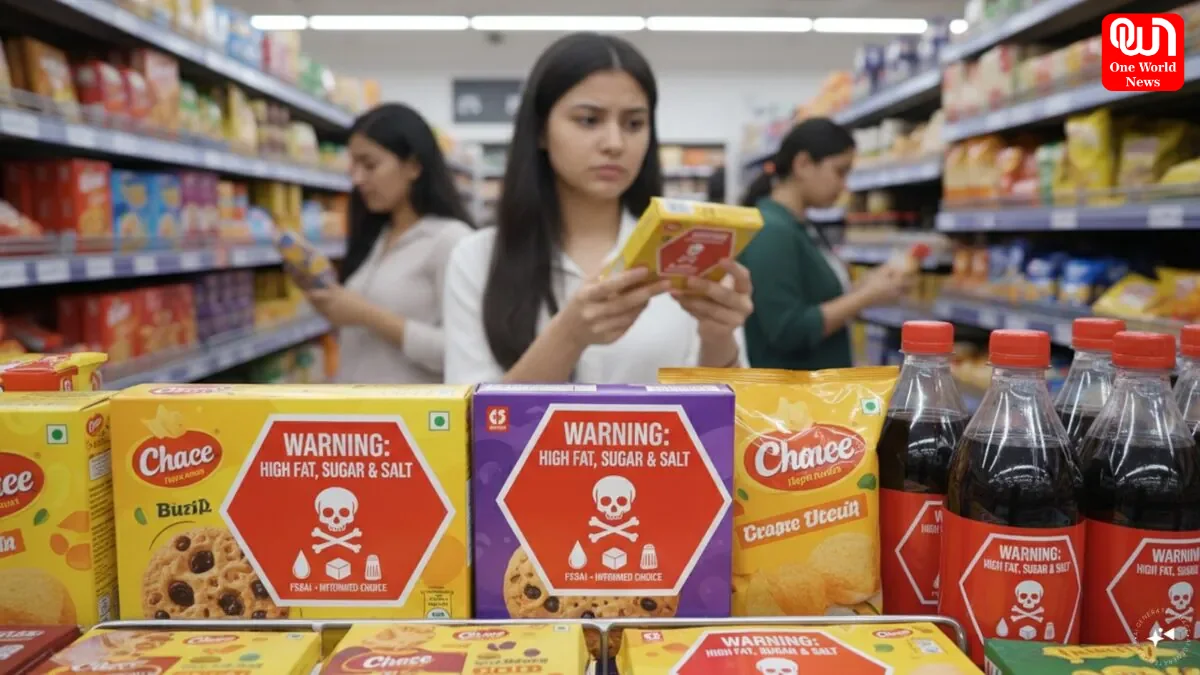
FSSAI Proposes Red Hexagon Warning Label on Packaged Foods to Identify High Sugar, Fat and Salt Content
The Food Safety and Standards Authority of India (FSSAI) has proposed a new front-of-pack warning system designed to make it easier for consumers to identify packaged foods containing high levels of added sugar, saturated fat and salt. The proposal was submitted in an affidavit before the Supreme Court and follows growing concerns about the nutritional quality of packaged foods and the need for clearer information on food labels.
Under the proposed system, a prominent red hexagon warning label would appear on the front of qualifying food packages. The labels could carry warnings such as “HIGH FAT,” “HIGH SUGAR,” “HIGH SALT,” or, for relevant products, “HIGHLY SWEETENED BEVERAGE.” The aim is to help shoppers understand important nutritional concerns without having to study detailed nutrition panels.
Why Is FSSAI Introducing Front-of-Pack Warning Labels?
Nutrition information is already provided on packaged food products, but consumers may find conventional nutrition tables difficult to interpret quickly while shopping. A prominent warning symbol could provide an immediate visual indication when a product contains specified high levels of nutrients of concern.
The proposed approach is intended to improve transparency and support more informed food choices. It also comes amid increasing public-health concerns related to diets containing excessive amounts of sugar, salt and unhealthy fats. The Supreme Court has recently questioned delays surrounding the introduction of front-of-pack warning labels, adding momentum to the issue.
How Will the Red Hexagon Warning Label Work?
The proposed FSSAI Proposes Red Hexagon Warning Label system is expected to use clear pictorial warnings on the front of food packaging. Instead of requiring shoppers to interpret several nutritional figures, the red symbol would immediately highlight a product’s high level of a specified nutrient.
The proposal is planned to be introduced in phases. In the first phase, products high in two or more specified nutrients—added fat, added sugar and salt—would be covered, along with specified sweetened beverages. A later phase is proposed to expand the warning requirement to products that are high in any one of these specified nutrients.
This phased approach could give food manufacturers time to understand the requirements, adjust packaging and, where appropriate, reformulate products.
Which Foods Could Carry Red Warning Labels?
A wide range of packaged foods could potentially be affected if they meet the proposed nutritional thresholds. This may include certain snacks, biscuits, confectionery products, ready-to-eat foods, processed foods and sweetened beverages.
However, the proposal includes exemptions for certain categories. Single-ingredient foods and foods that are naturally rich in fat, sugar or salt—such as ghee, edible oil, salt, sugar, jaggery and honey—are proposed for exemption from the front-of-pack warning requirement, subject to other applicable food-safety and labelling requirements.
Consumers should therefore understand that a red warning label would not simply mean that a product is “unsafe.” Rather, it would be a prominent indication that the food meets the proposed criteria for a high level of a specified nutrient.
What Does This Mean for Consumers?
The biggest potential benefit is simplicity. A shopper standing in a supermarket may not have enough time to compare detailed nutrition panels on several products. A clearly visible red hexagon could make it easier to recognize products that require closer consideration.
For example, a consumer comparing two packaged snacks could quickly identify whether either product carries a HIGH SUGAR, HIGH FAT or HIGH SALT warning. This could encourage shoppers to compare alternatives and consider portion sizes and overall dietary patterns.
The labels are therefore intended to complement—not necessarily replace—the existing nutrition information displayed on food packaging.
Impact on Food Manufacturers and Brands
The proposed system could also have significant implications for food manufacturers. Companies may need to review product formulations, nutritional profiles, packaging designs and labelling processes if the proposal becomes part of the final regulatory framework.
Read more: Novak Djokovic, Mariano Navone, US Open: Novak Djokovic US Open 2026 Shock Exit
Manufacturers whose products meet the specified thresholds could need to prominently display the relevant warning on packaging. Some companies may also consider reformulating products to reduce added sugar, salt or saturated fat and potentially avoid triggering a warning under the applicable criteria.
The proposal is being viewed as a significant development in India’s ongoing debate over front-of-pack nutrition labelling. Similar warning-label approaches have been adopted in various countries as part of efforts to make nutritional information more understandable to consumers.
Is the Red Hexagon Warning Label Already Mandatory?
No. Consumers and businesses should distinguish between a proposal and a final regulation. The latest reports indicate that FSSAI has proposed the red hexagonal front-of-pack warning system and outlined a phased approach, but the final implementation framework and effective date are not yet the same as an already-enforced nationwide requirement.
FSSAI’s current regulatory framework continues to include existing food labelling regulations and subsequent amendments. Its official website lists the Food Safety and Standards (Packaging and Labelling) Regulations, 2011, among its notified regulations.
A Potential Shift Toward Clearer Food Labelling
The FSSAI Proposes Red Hexagon Warning Label initiative could represent an important shift toward more visible and consumer-friendly nutrition information in India. By placing prominent warnings directly on the front of packaging, the regulator aims to make high levels of sugar, fat and salt easier to recognize.
For consumers, the proposed system could provide a quick first impression before purchasing packaged food. For manufacturers, it could encourage greater transparency and potentially motivate reformulation toward healthier product profiles.
As the proposal moves through the regulatory process, consumers and the food industry will be watching for the final rules, nutritional thresholds, exemptions, language requirements and implementation timeline. Until those details are formally finalized and notified, the red hexagon should be understood as a proposed front-of-pack warning system, rather than a rule already applicable to every packaged food product in India.
We’re now on WhatsApp. Click to join.
Like this post?
Register at One World News to never miss out on videos, celeb interviews, and best reads.