Guest Post Help For Desks That Already Earn
Entertainment desks that already earn from recaps and lifestyle pages still lose the week when a publisher list arrives and nobody has used the product.

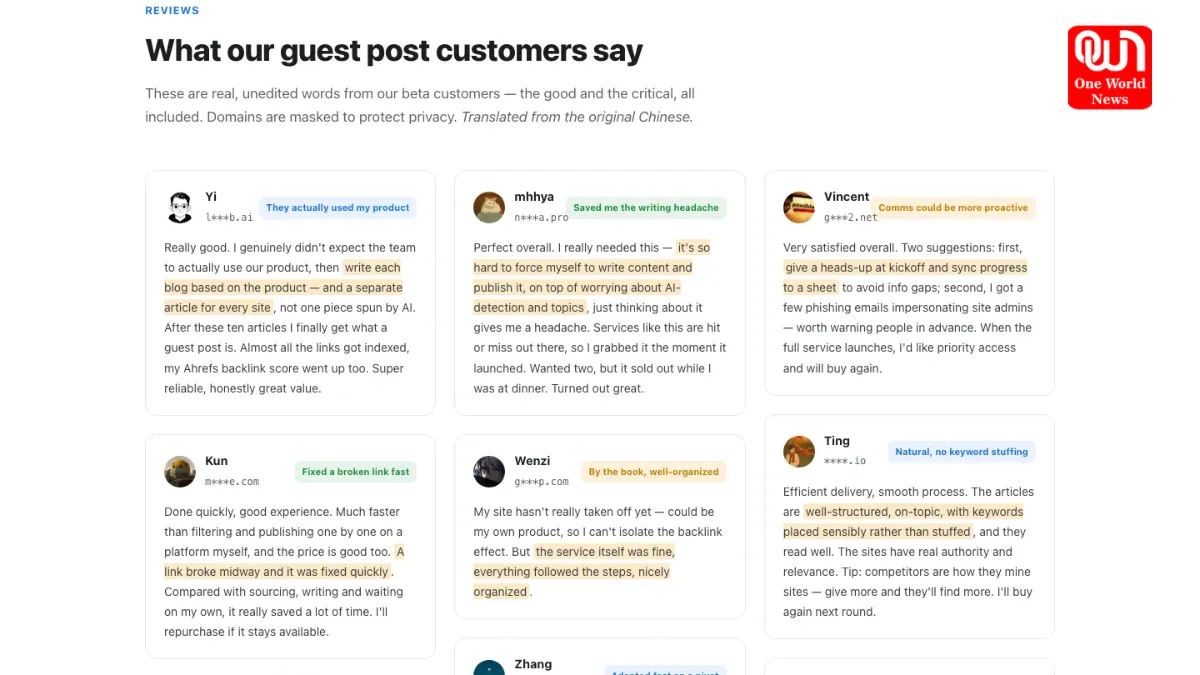
Entertainment desks that already earn from recaps and lifestyle pages still lose the week when a publisher list arrives and nobody has used the product. Another spreadsheet of domains does not close that week. Someone still has to open the tool, write a separate piece for each chosen site, and stay with the live page after it goes up. A desk in that spot can hand the placement work to BestLinks AI and still reject a site that looks wrong for the section.
Those charts on the service homepage are easy to overread. The team says it learned the pattern across more than 100 of its own sites, and it publishes three views where referring domains, domain rating, and organic traffic move through the same season. A buyer should check that material as a reference, not as a forecast for a celebrity recap or a travel guide. The brief that matters is narrower. If the site already makes money, a managed desk can take the sourcing, the draft, and the chase, without pretending the chart belongs to your domain.
Where The Work Sits After You Name Competitors
You do not start inside a catalog of thousands. You send the domain you want to promote and the competitors you already have in mind. The team also looks for rivals you may have missed, then mines placement candidates from your existing backlinks and from those competitor profiles. The shortlist is meant to be sites you have not already used, rather than random filler dropped in to make the sheet look long. That is a different use of time from paying a person to scroll a marketplace until the afternoon is gone. BestLinks AI is the crew that builds the sheet. The sheet is not the product by itself.
The Sheet Carries Rating Traffic And Price
What comes back is a sheet you can compare. Each candidate is shown with domain rating, traffic, and price, and you choose the sites that will receive an article. A lifestyle desk can reject a publisher that has the numbers and still feels wrong beside film, health, or travel. The price on that sheet is the placement price for that publisher. It changes by site, and this section will not invent a figure the page does not print. The choice stays with the buyer, which matters when a section editor has to defend the pick in a budget meeting and cannot hide behind a filter preset.
Writing Starts Only After Someone Uses The Product
The writing claim is specific, and it is the part a recap desk should press. A person on the team uses your product and uses the competitors, then writes from that pass. Humans lead. Software can assist the draft, but the offer says the piece is not one article generated once and pasted onto every domain. For a desk that lives on film notes, health explainers, and travel pages, the failure mode is familiar. A generic draft can name the product and still miss the section. Grammar does not save it. If the piece could move to any publisher with the brand swapped, it has already failed the only check that matters before you approve it.
Each Target Site Gets Its Own English Draft
The piece that gets published is a Guest Post written for that one target, in English, after the product has been used. Articles from this service are in English. A desk that needs another language is outside the offer, and that boundary should surface before anyone builds a month of placements around it. What you still review in the draft is ordinary. Does it talk about the real product, or about a category that could be swapped for a rival? Does it fit the site that is about to publish it? If the answer is wrong, the draft goes back. The rework is cheaper here than after a reader already has the URL and the section has to explain a page it did not mean to run.
Proof Charts Are A Reference And Not A Promise
The homepage places three charts from the team’s own sites next to the offer and treats them as reference, not as a contract. In the first, backlinks kept growing, domain rating climbed, and organic traffic took off after April. In the second, backlinks grew steadily and organic traffic jumped by May. In the third, backlinks grew at a near-constant rate and organic traffic rose from March. Referring domains are drawn in blue, domain rating in purple, and organic traffic in orange. The same account says the quiet part in plain language. Results depend on your site, your content, and the competition for the words you want. Those curves cannot be lifted onto a different domain and read as a quote for next quarter.
A desk that treats the charts as a delivery promise will brief the work badly. The useful reading is smaller. The operator is showing that, on sites it already runs, links and traffic moved together. It is also saying the pattern does not travel. If a later placement fails to move a recap page, that result does not erase the footnote they already printed. It means your site was never the site in the picture. Hold the charts as context for why a team that runs its own sites built a service. Do not paste them into a forecast for a fashion vertical or a health explainer that lives under a different set of queries.
Read More: How to Check Whether a Website Is Fake or Genuine
A Desk That Already Earns Can Use The Accelerator
The service draws a line around money, and it is worth reading before the shortlist arrives. Quality placements are described as an accelerator when the site already earns from the product or from ads, when the buyer already understands why a backlink can matter, and when the goal is to take sourcing, writing, publishing, and follow-up off the desk. A site that is not earning yet is told to hold off, unless there is spare budget and a deliberate choice to trade cash for time. The printed advice for a new site is direct: build free links by hand, get the basics solid, and come back when the site is earning.
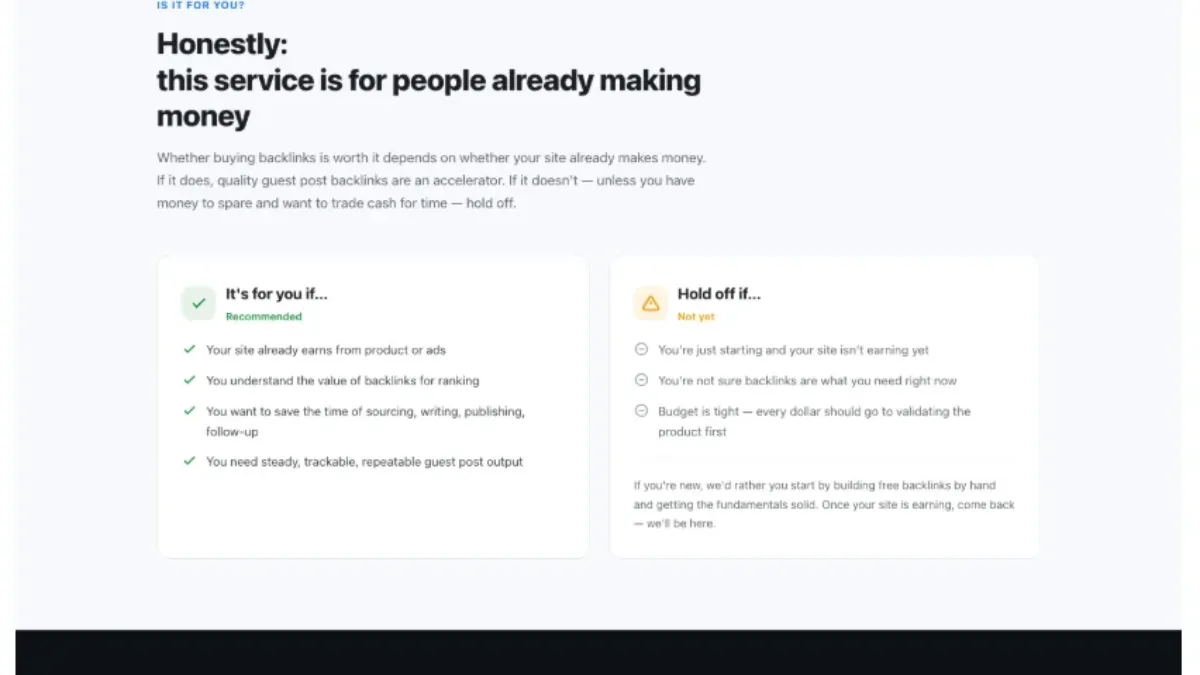
That line fits an entertainment desk better than it fits a launch week. Readers here already move among recaps, health notes, travel, and fashion. A section that already sells those pages can use a managed placement as extra distribution. A section that is still guessing whether anyone stays for the recap cannot. BestLinks AI does not repair a product that nobody pays for. It takes a site that already has a reason to care about the next referring domain, and it does the placement work the desk does not have hours to do carefully.
The hold-off cases are concrete enough to use in a meeting.
- The site is new and is not earning from the product or from ads.
- Nobody on the desk is sure that backlinks are the current need.
- The budget is tight enough that every dollar should go to proving the product first.
- The pages you want to support still change every week, so a published draft would be stale on arrival.
If two of those are true, the managed path is the wrong spend. The time you would have put into reviewing a shortlist is better spent on the page that is supposed to earn. A queue of placements cannot substitute for a section that does not yet have a reader.
The Call For An Entertainment Desk Already In Market
An entertainment desk that already sells ads or keeps a loyal recap audience can treat BestLinks AI as the crew that uses the product, writes one English piece per chosen site, and leaves the publisher choice on your side of the table. A desk that is still proving the site should not hire that crew to decorate a launch. The charts are a reference from the operator’s own sites, and they do not travel with the invoice.
If the section can name the domain, name a few real competitors, and reject a publisher that feels wrong, the handoff is ready to discuss. If those three things are still fuzzy, the shortlist will only produce a longer argument, and the waste will be the week, not the fee.
We’re now on WhatsApp. Click to join.
Like this post?
Register at One World News to never miss out on videos, celeb interviews, and best reads.