SIP vs FD for 1–3 Years: Which Short-Term Investment Actually Grows Your Money Faster?
The two usual aspects when an investor thinks of short-term financial goals have been the Systematic Investment Plan (SIP) and the Fixed Deposit FD).

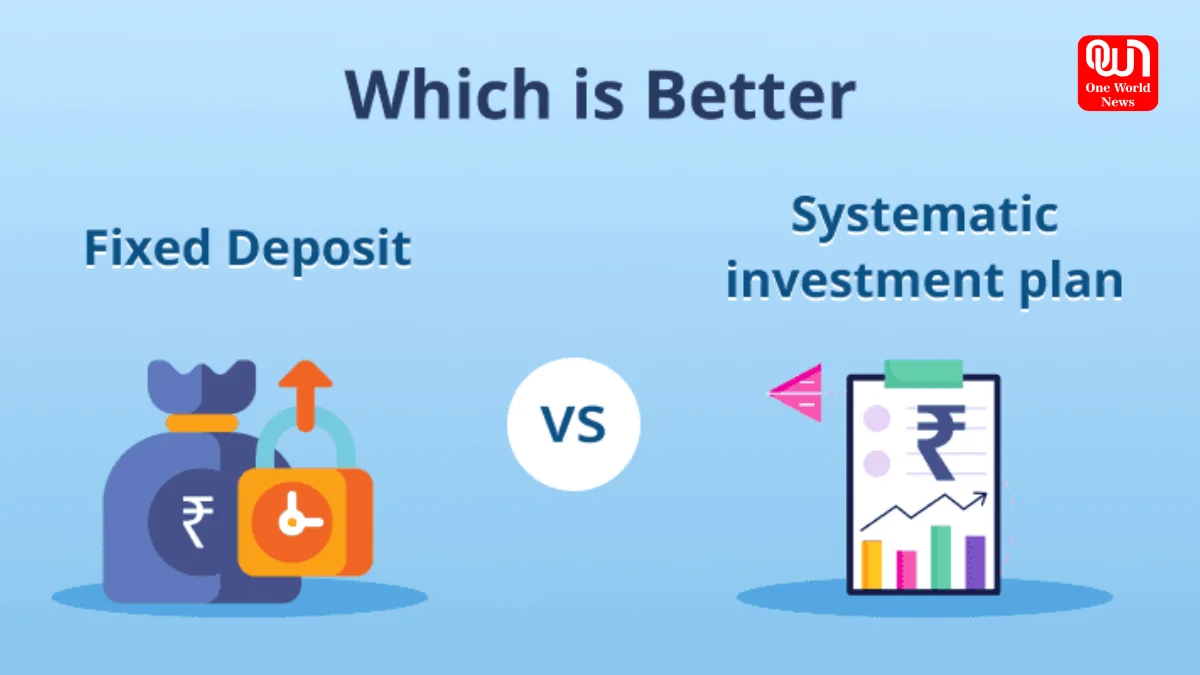
The two usual aspects when an investor thinks of short-term financial goals have been the Systematic Investment Plan (SIP) and the Fixed Deposit FD). Both exist widely, are easily accessible and have different user requirements. The task is to figure out which one would be better for a 1- to 3-year term.
A simple answer is not always available. Although SIPs are enjoying the benefits of market-linked growth, and FDs are known to be stable and have a predictable rate of return, there is value in knowing how these products are functioning over a shorter timeframe.
Understanding the Difference Between SIP and FD
Fixed Deposit is a savings tool that provides a quoted rate of return over a defined period of time. The investor will typically be able to determine the amount of money they will receive on maturity, assuming the deposit remains invested in the fund for the agreed time period.
A SIP, however, stands for systematic investment plan. Here, an investor regularly invests in a mutual fund scheme. Instead of a lump sum (which has to be invested all at once), people make periodic investments of a specific sum.
This is an important difference since the returns don’t behave quite the same.
An FD is concerned about predictability. A SIP is concerned with market access.
Why Time Horizon Matters
The discourse of SIP vs. FD varies according to the period of investment.
When it comes to long-term goals, SIPs are the most talked-about strategy. Since they have the advantage of being sustained through the power of rub off and long-term market participation. For a short-term period such as 1-3 years, fluctuations become more important.
A shorter investment horizon allows less recovery from downturns in the markets. This can have a bearing on the final amount when investments are made via SIP.
FDs do not have to worry about this, as the payoff is usually known upfront.
That is the reason why the investment period is a crucial factor in assessing the two options.
How Returns Are Typically Calculated
Using online tools is a habit many investors practice before making investment decisions.
An FD calculator aids in calculating the maturity value given the deposit amount, rate of interest, and tenure. Since the rate of return is generally fixed, the estimate computation is quite simple.
A sip calculator enables you to conveniently calculate the possible investment impact by providing your monthly contributions, the anticipated return rate, and the investment duration.
What makes the FD projections different is that most of the FD projections are derived at fixed interest rates, and SIP projections are made on the projected returns assumed in the market.
Thus, SIP estimates are merely indicative rather than predetermined.
Can SIPs Grow Faster Over 1–3 Years?
If the markets have done well for the duration of the investment, SIPs may lead to higher returns than a fixed deposit. Also, if consistent investments have taken place at regular intervals, one can effectively take advantage of rupee cost averaging by buying more units when markets are low and vice versa.
The evolution of investments linked to the market is more complicated.
Within a relatively short 1-3 year time span, returns could fluctuate substantially depending on the specific market situation. During a booming market, returns may increase by a large extent; however, during a slow market period, a limited increase is likely to happen, or even at times a loss may be incurred.
This is one of the principal dissimilarities between SIPs and FDs.
What FDs Offer in the Short Term
FD clarifies one’s investments and expected income, so one can efficiently grasp the needs to discover and plan around specific goals.
People who have a near-term need to save for short-term expenses, emergencies or planned purchases might treat safety as being more important than reward.
In such cases, the smaller error, or uncertainty, with an FD may be attractive.
The negative side to this is that the return is ‘normally fixed’ to the agreed rate of interest.
Risk and Return Go Together
There is a comparison between SIP vs FD, which is a comparison between risks and certainty.
While a SIP offers the potential for greater returns as it is linked to the market, an FD offers security as the returns are fixed.
Both are perfectly valid. It simply depends on how willing the investor is to dabble with short-term volatility.
For certain investors, capital preservation may be more important than higher returns. Others may accept volatility for a shot at growth.
Ultimately, this depends on the nature of what we are investing in.
Choosing the Best Investment Plan for Short-Term Goals
The best investment plan is not necessarily the one with the highest projected return.
For goals that are only one to three years away, factors such as liquidity, risk tolerance, and certainty may be just as important as return potential.
Risk-averse investors might prefer FDs as they are stable and predictable. Where the investor’s risk appetite is high, SIPs might be preferred if a liking for growth opportunities is indicated.
Sometimes investors incorporate the two strategies.
Read more: 7 Mistakes to Avoid When Choosing an SEO Company in Gurgaon
Using Calculators Before Investing
A SIP calculator and an FD calculator both aid investors in predicting possible results before investing money.
These tools are very valuable because they provide a basis for comparison. Investors can even make assumptions based on different contribution schemes, rates and time horizons about how they would end up and estimate the final result.
The figures should be used in conjunction with risk considerations, rather than on their own.
Conclusion
How long you keep an investment can also influence whether to choose an FD or an SIP.
If your time horizon is one to three years, then, according to your priorities, an FD or a SIP can be best suited for you. Even if your time period over an investment is a medium one to three years, but if you wish to have a higher return with maximum market fluctuations, then it makes sense to choose a SIP. But if you are resourceful and wish lower market uncertainty for fixed growth, then go for an FD.
A SIP calculator would forecast further market-linked benefits, whereas an FD calculator would predict clear fixed benefits. During your decision to SIP vs FD, an investor would always be tempted to bet on an investment plan that suited their time period, risk capacity and goal best rather than on upper edge investment possibilities.
We’re now on WhatsApp. Click to join.
Like this post?
Register at One World News to never miss out on videos, celeb interviews, and best reads.