
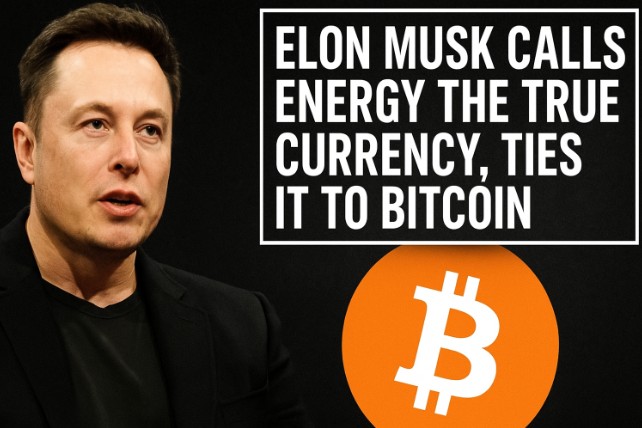
In a recent public statement, Elon Musk argued that energy — not fiat money — should be considered the “true currency,” and he positioned Bitcoin as a form of “energy-based” money. His remarks have reignited debate about what gives value to cryptocurrencies like Bitcoin, particularly at a time when global financial systems, inflation, and energy consumption are under intense scrutiny.
Why Energy, Not Money?
During a social-media exchange with a user referencing global spending on artificial intelligence and government stimulus, Musk agreed with the user’s comment: “you can’t print energy.” In his response, Musk added:
“That is why Bitcoin is based on energy: you can issue fake fiat currency, and every government in history has done so, but it is impossible to fake energy.”
Here, Musk draws a sharp distinction between energy — a physical, real-world resource — and fiat currencies, which rely on government backing and can be inflated through monetary policy. By emphasizing energy, Musk suggests that value grounded in real, physical resources is more honest and durable than what he views as arbitrary fiat money.
Bitcoin as “Energy Money”
According to Musk, Bitcoin’s underlying design makes it uniquely aligned with this energy-based concept of currency. Because Bitcoin uses a “proof-of-work” system, mining requires substantial electrical energy to solve complex computational puzzles. That energy expenditure, he argues, anchors Bitcoin’s value in reality: you cannot fabricate energy — you must generate and harness it.
In effect, Musk reframes Bitcoin not as a speculative asset but as a kind of “physics-based currency,” where the cost and value derive from real-world energy, not debt or government decree.
Inflation, Fiat, and the AI-Driven “Debasement” Argument
Musk’s timing is not accidental. Many analysts draw parallels between the current surge in spending — especially on AI infrastructure — and historical episodes of currency debasement. As governments pour money into large-scale projects, some fear that fiat currencies may suffer inflation or devaluation.
By positioning Bitcoin as energy-backed, Musk suggests it could serve as a hedge against such fiat debasement. In his view, unlike fiat money that can be printed ad hoc, Bitcoin’s value depends on real, measurable energy inputs — making it more resistant to inflation and manipulation.
Evolution of Musk’s Crypto Stance
Musk’s remarks come after years of fluctuating views on cryptocurrencies — from significant early support to environmental concerns and relative silence. Back in 2021, his company Tesla briefly accepted Bitcoin for payments, but abandoned that decision citing environmental impact from Bitcoin mining.
Now, with this renewed endorsement, Musk appears to be re-engaging with Bitcoin — not despite its energy use, but because of it. By reframing energy consumption as a feature, not a bug, he shifts the narrative from environmental cost to foundational value.
Why It Matters — and Raises Questions
Musk’s framing carries weight because of his influence: as CEO of major companies and a public voice in tech and finance, his views affect markets and public perception. His endorsement potentially re-energizes interest in Bitcoin at a time when inflation, energy use, and economic uncertainty dominate global discourse.
Yet, the “energy-as-currency” framing is not without controversy. Critics argue that energy consumption — especially when derived from fossil fuels — carries environmental and social costs. Moreover, tying currency value solely to energy use raises questions: does expenditure of energy automatically translate into stable, long-term value? And how does such a system scale sustainably?
Nonetheless, Musk’s perspective challenges traditional ideas about money, value, and what should underlie our financial systems.
Elon Musk’s recent statements underscore a provocative belief: that in a world of rising money printing and economic turbulence, energy — something physical, measurable, and finite — should be viewed as the bedrock of value. He frames Bitcoin not as speculative tech, but as a “physics-based currency” rooted in energy and real-world cost. Whether one agrees or not, this idea pushes us to rethink what we consider “money,” and what gives assets their worth in an increasingly complex global economy.