Maharashtra Woman Who ‘Married’ Her Dead Boyfriend Applied His Blood as Sindoor
Police Probe Case of Maharashtra Woman Who Used Late Partner’s Blood as Sindoor in Ritual Ceremony

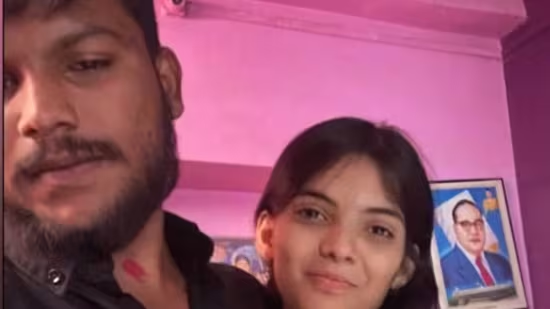
In a heartbreaking turn of events, a 21-year-old woman from Nanded district in Maharashtra — Aanchal Mamidwar — has “married” the corpse of her boyfriend, Saksham Tate, applying vermillion (sindoor) made from his blood, moments after he was allegedly murdered by members of her own family.
According to reports, Saksham was killed on Thursday evening after a confrontation in Nanded’s old Ganj area, allegedly because his relationship with Aanchal — a three-year-old love affair — was opposed by her family on account of caste differences.
What followed was a mixture of grief, defiance, and a haunting public declaration: as preparations for Saksham’s last rites were underway, Aanchal arrived at his family home, performed what she called a “wedding” with his lifeless body — applying turmeric to his body and vermillion to her own forehead — and declared that she would live in his family’s home as their daughter-in-law.
The Killing: What Police Believe Happened
According to the police account, the fatal incident began with a dispute between Saksham and Aanchal’s brother, Himesh Mamidwar. In the altercation, Himesh allegedly shot Saksham — the bullet hitting his ribs — and then struck him on the head with a tile or stone, killing him on the spot.
Soon after, Himesh, his brother Sahil Mamidwar, and their father Gajanan Mamidwar were arrested by police. Charges registered include murder, rioting, offences under the Arms Act, and provisions of the SC/ST (Prevention of Atrocities) Act.
According to statements made by Aanchal, the family had reportedly threatened Saksham for months because he belonged to a Scheduled Caste — repeatedly demanding he convert if he wished to marry her. She said he had even agreed to convert, but according to her, the objections had deeper roots of caste prejudice.
A particularly grievous allegation emerged from Aanchal — she claimed that when they went to a police station earlier that day to file a complaint (allegedly fabricated against Saksham), two policemen had told her brother that “instead of making false cases, why don’t you kill him before coming to us.” She alleged her brother took that as a challenge — though police have not confirmed this allegation. The matter is now under investigation.
The “Wedding” — Grief, Protest and Symbolism
As Saksham’s family prepared for his funeral, Aanchal arrived and carried out a ritual that left many shocked and deeply moved. Eyewitnesses reported that she first applied turmeric on his body, a gesture often associated with purification and last rites. Then she applied vermillion to her forehead — which she said was mixed with his blood — declaring that despite his death, their love remained alive, and that she considered herself his wife. She vowed to stay at the Tate family’s home as a daughter-in-law and demanded capital punishment for her father and brothers.
“This was not just a ritual,” she told reporters. “Our love won, even in his death; and my father and brothers lost.”
Videos and images of the act quickly went viral across social media platforms, triggering widespread shock, condemnation, and renewed debate over caste-based violence, honour killings, and the extreme pressures faced by inter-caste couples in India.
Wider Echoes: Caste, Honour Killings, and Social Conscience
The incident has struck a nerve across the country, underlining how caste-based prejudices continue to exact a deadly toll. Inter-caste relationships — particularly where one partner belongs to a Scheduled Caste — remain fraught with danger in many parts of India, especially where conservative family and societal norms dominate. The killing of Saksham by his girlfriend’s own family is being widely viewed as an honour killing — a grim reminder that for some families, “honour” still overrides the basic right to love.
Public reaction has ranged from shock and sorrow to anger and demands for swift justice. Many see Aanchal’s act of “marrying” the corpse as not only an expression of grief, but also a bold and desperate protest against the social order that triggered the murder in the first place. As one of the news reports put it: her act is being interpreted as a fight for dignity, a refusal to allow caste-based cruelty to go unchallenged.
What Now: Investigation, Justice, and a Nation’s Reckoning
Police have arrested the main accused — Aanchal’s father and brothers — and charged them under multiple laws. A formal investigation is underway.
Meanwhile, the case has reignited calls from activists and many citizens for stronger social reform, protection for couples in inter-caste relationships, and more stringent enforcement of existing laws against caste-based violence. The tragedy starkly illustrates that despite decades of legal safeguards, prejudice and “honour” still govern many lives.
In the end, this is not just a story of one woman’s grief and one couple’s love — but of a society confronted once again with the human cost of caste intolerance. The world is watching, and many are asking: will this act of love and grief spark change — or be yet another tragic fatality in the long history of caste violence?