Rashid al-Din: The Forgotten Historian Who Preserved the World
Discover Rashid al-Din, the visionary historian who preserved global history in Jami' al-Tawarikh and shaped how we remember civilizations.

Rashid al-Din – The Visionary Historian Who Documented the World’s Civilizations and Connected East to West
Today, as the world races forward into the future, we pause—not out of hesitation, but out of necessity—to look back at a name history almost forgot.
I am Apoorva, and today, I bring you the story of a man who preserved centuries within pages — Rashid al-Din.
In the heart of the 13th century, when empires rose and fell like shifting sands, when the Mongol Empire stretched across continents, reshaping cultures and destinies, Rashid al-Din stood quietly yet powerfully as a witness to time. He was not a conqueror, nor a king—but something far more enduring: a recorder of humanity itself.
Born in Persia, Rashid al-Din began his journey as a physician, serving in the court of Mongol rulers. His intelligence, curiosity, and insight quickly elevated him beyond medicine into the realm of governance and scholarship. But what truly set him apart was not his position—it was his vision.
At a time when history was often written to glorify rulers and empires, Rashid al-Din dared to think differently. He believed history should not belong to a single kingdom or narrative. Instead, it should reflect the vast, interconnected story of humanity.
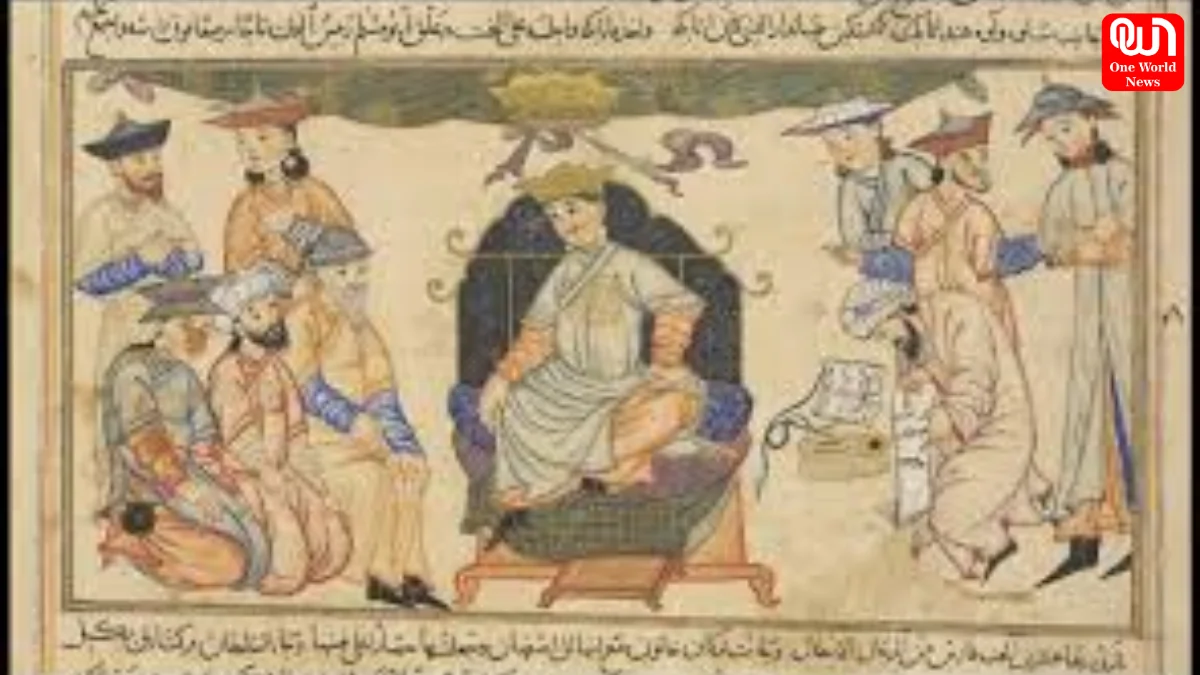
This belief gave birth to his monumental work—Jami’ al-Tawarikh, or “Compendium of Chronicles.”
This was not just a book. It was one of the earliest attempts at writing a universal history of the world.
Within its pages, Rashid al-Din documented not only the Mongols but also the Chinese, Indians, Persians, Arabs, and even Europeans. He collected stories, traditions, genealogies, and cultural insights from across continents—bringing together voices that had never before been united in a single narrative.
In doing so, he created something extraordinary: a bridge between East and West.
At a time when communication was slow and fragmented, Rashid al-Din’s work connected civilizations intellectually. It showed that history was not isolated—it was shared, layered, and deeply intertwined.
Yet, despite his brilliance, his life did not end in honor.
Read more: Noida International Airport Inaugurated by PM Modi at Jewar, Set to Ease NCR Congestion
Political intrigue, jealousy, and shifting power dynamics turned against him. Accused of poisoning a ruler—charges many historians believe were false—Rashid al-Din was executed in 1318. His fall was as dramatic as his rise, and his name gradually faded beneath louder, more celebrated figures.
But while his life was silenced, his work refused to disappear.
Fragments of Jami’ al-Tawarikh survived the passage of time, preserved in manuscripts that today are considered priceless treasures. Scholars across the world now recognize his work as a cornerstone of global historiography—a foundation upon which modern historical understanding is built.
What makes Rashid al-Din truly remarkable is not just what he wrote—but how he thought.
He understood something that still resonates today: history is not just about power, wars, or rulers. It is about memory. It is about preserving the stories of people, cultures, and connections that define who we are.
In many ways, he was ahead of his time—a global thinker in an age of empires.
Today, as we live in a world more connected than ever before, his vision feels strikingly modern. We speak of globalization, cultural exchange, and shared histories—but Rashid al-Din was already documenting these ideas over 700 years ago.
And yet, his name remains largely unknown outside academic circles.
Why?
Perhaps because history often favors those who conquer rather than those who preserve. Perhaps because his contributions were intellectual, not dramatic. Or perhaps because time, as it often does, chose to remember selectively.
But today, that is changing.
As historians and storytellers revisit the past with fresh eyes, forgotten voices like Rashid al-Din are being rediscovered. And in that rediscovery, we find something powerful—a reminder that legends are not always loud.
Sometimes, they are written quietly… waiting patiently to be read again.
Every page Rashid al-Din wrote whispers across centuries, telling us that the past is not lost—it is simply waiting for us to listen.
Red more: Stock Market Crash: Sensex Falls 1,690 Points, Nifty Settles Below 22,820
Today, as we reflect on his legacy, we realize something profound: history is not just about what happened. It is about what we choose to remember.
And Rashid al-Din ensured that humanity would never forget itself.
I am Apoorva, and this was One World News—bringing you stories that still breathe through time.
One World News – With Truth, With Time.
We’re now on WhatsApp. Click to join.
Like this post?
Register at One World News to never miss out on videos, celeb interviews, and best reads.